
“Towa and the Guardians of the Sacred Tree” Review for PlayStation 5
I hadn’t even heard of ‘Towa and the Guardians of the Sacred Tree’ until recently, and it felt like it appeared out of nowhere with its mix of roguelite mechanics and Shinto-inspired mythology. I’m not too familiar with Brownies Inc., but off the bat I could tell they have a knack for charming artistic sensibilities. I went in curious to see how they’d blend this softer, character-driven style with the more demanding expectations of the roguelite genre. What I found was a game that doesn’t quite reach the heights of its inspirations but still left me engaged with its warmth, world-building, and thoughtful systems.
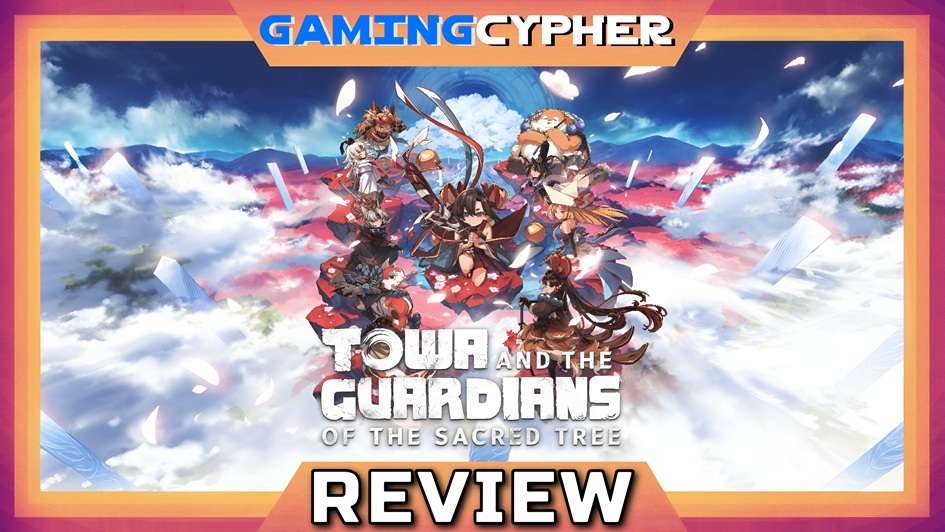
You step into the role of Towa, the priestess of Shinju Village, who carries the heavy responsibility of protecting the sacred tree from Magatsu’s corrupting forces. She isn’t alone in this fight; eight guardians stand by her side, each with their own distinct abilities and unique combat style. The game is built around the idea of pairing up with another guardian, and this dual-character system shapes nearly every encounter. Switching between sacred swords and staffs, I experimented with different partners to see which combinations clicked, and it quickly became clear that combat was meant to encourage variety. Every guardian has their strengths, so finding the right mix of weapon customization and synergy with Towa kept me tinkering with new builds from run to run. Combat itself is fast-paced and accessible, though it leans a little too heavily on simplicity at times. While moment-to-moment battles were enjoyable, I occasionally found myself wishing for a bit more depth in the enemy variety or sharper precision in the controls. Still, chaining attacks together with a partner guardian and experimenting with newly forged weapons added enough experimentation to keep me from getting bored. The upgrade system, by contrast, is far more involved, with plenty of ways to enhance weapons, train skills, or summon Graces to shift the balance of a run. The roguelite structure, combined with these layered systems, meant I was always looking forward to what my next attempt might bring.
Where “Towa and the Guardians of the Sacred Tree” really shines is in how it ties the roguelite loop to the evolving village. Between runs, Shinju Village develops and changes, its people opening up as I invested time in training, smithing, or simply getting to know them better. Building relationships with the villagers added a surprising amount of texture to the experience, and I enjoyed learning more about their customs and daily lives. This emphasis on bonds, both with your guardians and the wider community, gives the game a soul that a lot of roguelites tend to neglect. The narrative isn’t quite as gripping as I hoped it would be, though. While the Shinto mythology influences are refreshing and give the world its own personality, the story never fully grabbed me in the way it seemed designed to. Some of the timelines and quests felt like missed opportunities, and I often found myself more interested in the gameplay loop than the unfolding tale. That said, the music elevates nearly every scene, and the soundtrack blends perfectly with the visual presentation, which is striking in its own right. From lush, colorful environments to the dreamlike village design, the art direction feels carefully considered and always pleasant to look at.
One of the more curious aspects of “Towa” is how it straddles genres. On one hand, it has all the hallmarks of a roguelite: procedural dungeons, randomized builds, and repeatable runs. On the other, there’s a cozy-game undercurrent, where spending time in the village and fostering bonds is just as important as slaying monsters. This hybrid nature makes it stand out, but it also leads to uneven pacing. Some players may find the balance between intense dungeon-crawling and slow village interactions refreshing, while others may see it as a tonal clash. Personally, I appreciated the attempt, even if the execution didn’t always land. The dual-character system is another example of an idea that feels promising but not fully realized. Pairing Towa with a guardian opens the door for unique team strategies, but after a while, repetition crept in. Boss battles, while initially exciting, recycled patterns too often, and the arenas lacked enough variety to keep encounters feeling consistently fresh. These shortcomings don’t ruin the experience, but they’re noticeable, especially for anyone used to the sharp precision and depth of games like “Hades.”
That comparison is hard to avoid. With “Hades II” looming on the horizon at the end of this month, “Towa and the Guardians of the Sacred Tree” has a huge risk of being overshadowed. It doesn’t reach the same level of polish or narrative impact, but it does carve out its own identity through its atmosphere, its emphasis on community, and its heartfelt presentation. The imperfections don’t erase the fact that this is a roguelite with genuine charm. At its best, “Towa” delivers a blend of action and heart that kept me invested for far longer than I expected. Its flaws are real, but so is its personality, and I can’t help but admire how much care went into its world, characters, and overall design. It may not be a genre-defining masterpiece, but it’s a game with plenty to offer anyone willing to meet it halfway.
8/10
For more information, visit HERE
Related: Nick Navarro Reviews

Gaming since I was given an original Nintendo as a kid. I love great storytelling and unique ingenuity. When both collide in a single game, I'm a happy gamer. Twitter/IG @NickNavarro87





More Stories
Red Dead Online this Month Features Bonuses for Every Role, Double Rewards for Every Bounty, Collector Set Sales, and More
theHunter: Call of the Wild New ‘Peru Hunting Reserve’ DLC Drops June 16 for PC, Xbox, and PlayStation
007 First Light Review for PlayStation 5