
“Cairn” Review by Nick Navarro
“Cairn” isn’t about conquering a mountain so much as learning how much of yourself you’re willing to leave behind on the way up. From the moment I begin the ascent of Mount Kami as professional climber Aava, the game frames progress as something earned through restraint rather than speed. This is a climb that demands planning before commitment, awareness before action, and humility in the face of failure. Every route is self-chosen, every mistake is visible, and every success feels quietly hard-won. By stripping away traditional signposts and presenting the mountain as both obstacle and companion, “Cairn” establishes a slow, deliberate rhythm that turns survival, strategy, and personal resolve into inseparable parts of the experience.
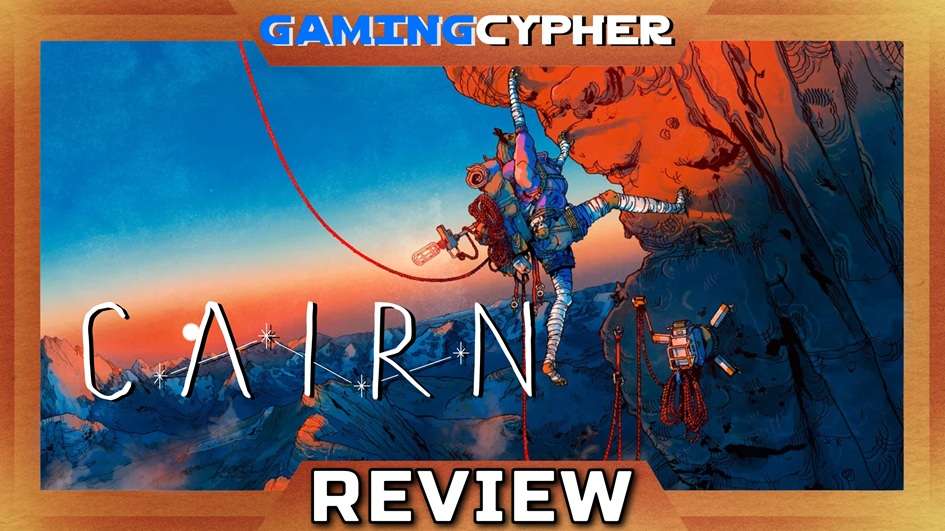
In this game, you step into the boots of Aava, a professional mountaineer determined to become the first person to reach the summit of Mount Kami. The premise is simple, but the execution is anything but. The mountain isn’t just a backdrop or a level structure; it’s the entire game, an imposing presence that demands respect. From the ground, I’m encouraged to study the rock face, trace possible routes with my eyes, and commit to a plan long before I ever leave solid footing. Once I’m on the wall, there’s no autopilot, no generous correction system quietly smoothing over my mistakes. Every decision sticks. The climbing itself is the heart of the experience, and it’s handled with a limb-based control scheme that feels both intuitive and unforgiving. I manually place Aava’s hands and feet, shifting her posture, redistributing her weight, and watching how her body reacts to each movement. Overextend a limb for too long, cling to an awkward position, or push her stamina past its limits, and gravity will remind you who’s in charge. When a fall happens, it never feels cheap. It feels earned, which somehow makes picking myself back up and trying again feel worthwhile rather than demoralizing.
What really elevates the system is the complete absence of a traditional user interface. There are no stamina bars, no flashing warnings, and no numerical safety nets. Instead, I’m forced to read Aava herself. Her breathing grows ragged when she’s exhausted. Her limbs begin to tremble under strain. It creates a surprisingly intimate connection between player and character, one where success depends on paying attention not to meters but to subtle physical cues. Climbing difficult sections becomes a strange kind of duet, where I’m responding to her condition as much as the terrain in front of us. Every wall in “Cairn” feels like a boss fight, not because of spectacle, but because of focus. Progress is slow, methodical, and tense. Placing pitons to create checkpoints is essential, and deciding when and where to secure them becomes a strategic puzzle in its own right. Push too far without anchoring yourself, and you risk losing significant progress. Play it too safe, and you may run out of critical resources later on. That constant balancing act gives the climb a persistent edge, even during quieter stretches.
Survival elements layer neatly on top of the climbing mechanics without overwhelming them. Managing food, water, medicine, chalk, finger tape, and pitons adds long-term pressure to the ascent. I frequently had to make judgment calls about whether to press on or set up a bivouac to rest and recover. Equipment degrades, supplies dwindle, and the mountain offers only limited opportunities to replenish what you’ve lost. It reinforces the idea that Mount Kami isn’t something you conquer in a single heroic push; it’s something you endure over time. Narratively, “Cairn” is understated but effective. As Aava climbs higher, I occasionally encounter other climbers or hear voices from those still on the ground. These moments provide context, hints of the mountain’s history, and glimpses into the personal stakes driving Aava forward. The story isn’t delivered through heavy exposition or dramatic cutscenes. Instead, it unfolds naturally, carried by isolation, reflection, and the slow accumulation of sacrifice. The question of what Aava is willing to give up to reach the summit lingers quietly in the background, growing heavier with each ascent.
Artistically, the game is striking. The stylized visuals give Mount Kami a colorful, textured identity that’s both beautiful and practical, making it easier to read the rock face while still feeling like a distinct place. The art direction has a confident, graphic quality that suits the game’s tone, even if a few scenes struggle to convey Aava’s inner emotions through facial animation alone. Those moments are rare, though, and they do little to undermine the overall cohesion of the presentation. The audio design deserves special mention. The music, handled by a team with awesome credits such as “Limbo,” “Inside,” “Control,” and “Cocoon,” is subtle but emotionally resonant. It never overwhelms the experience, instead rising gently during key moments and receding into near silence when focus is required. Combined with the sound of wind, shifting gear, and labored breathing, it creates an atmosphere that kept me fully immersed for hours at a time.
Beyond the main story, Expedition mode offers additional ways to engage with the systems. Being able to choose between characters, select climbing styles like alpine or free solo, and share results adds replay value without detracting from the core experience. Accessibility options are also present, allowing players to tweak the difficulty. While these adjustments can make the game more approachable, they may soften some of the tension that makes “Cairn” so compelling in the first place. There are minor missteps here and there, and the game’s deliberate pace won’t appeal to everyone. It demands patience, attention, and a willingness to fail repeatedly in pursuit of progress. But for those willing to meet it on its own terms, “Cairn” delivers something rare. It’s a game that turns strategy and perseverance into emotional tools, where reaching the next ledge feels as meaningful as reaching the summit itself.
By the time I stepped back from Mount Kami, I realized how often the climb had pulled me in with quiet confidence rather than spectacle. “Cairn” doesn’t shout for your attention; it earns it. And because of that, it stands out as one of the most memorable and thoughtful games I’ve played in a while, and honestly, I can see this as an awards contender at the end of the year.
9/10
For more information, visit HERE
Related: Nick Navarro Reviews

Gaming since I was given an original Nintendo as a kid. I love great storytelling and unique ingenuity. When both collide in a single game, I'm a happy gamer. Twitter/IG @NickNavarro87





More Stories
Red Dead Online this Month Features Bonuses for Every Role, Double Rewards for Every Bounty, Collector Set Sales, and More
theHunter: Call of the Wild New ‘Peru Hunting Reserve’ DLC Drops June 16 for PC, Xbox, and PlayStation
007 First Light Review for PlayStation 5