
Gooey Review for Steam
developed and published by Turbo Pixel
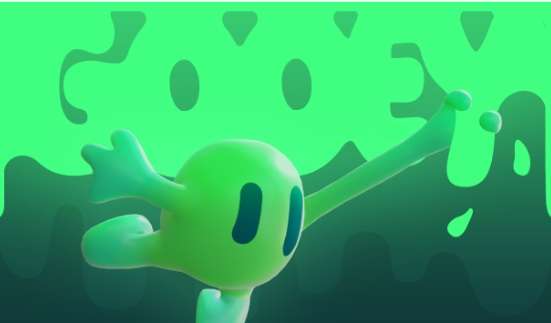
TL:DR: 10/10 An accidental masterpiece of accessible design that deserves recognition for what it actually is, not what it was marketed to be.
Story
Gooey opens with a cute animated sequence showing a scientist creating a little green goo character by mixing several glowing science beakers. Once born, the scientist and goo gaze into each other’s eyes, then the goo leaps away, breaking the camera and disappearing into who knows where. This opener seems to be setting up an “escape from the L.A.B.” scenario, but,in terms of plot and character development, the opening cut scene is all there is.
Minimalist storytelling isn’t a problem when it comes to platformers and is especially non-problematic for retro games, which the devs have openly stated, Gooey is retro-inspired.
I mean, for decades, no one really paid too much attention to why Bowser stole Peach, the dino just did. No one was terribly invested in how Mr. Pac-Man met Ms. Pac-Man. As I am writing this, I’m not sure if they were supposed to be a couple, or maybe brother and sister. The point I am trying to make is that I can tell that Gooey’s lack of narrative is not a bug; it’s a feature, meant to evoke the thrill of pure gameplay like Galaga/Galaxian and Tetris.
So the scientist who created you vanishes from the rest of the experience? Let it go. That’s not a father wound you’re feeling, it’s the 80s baby.
Gameplay
Reading the Steam page for Gooey, you could almost guess that the premise for the game came from one idea: “the Goopling hook.” An idea so perfect and adorable, it makes sense that someone would then want to create an entire game for it.
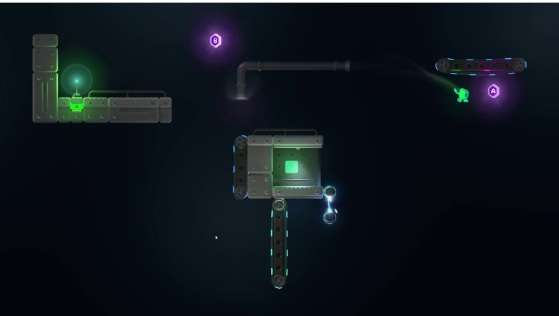
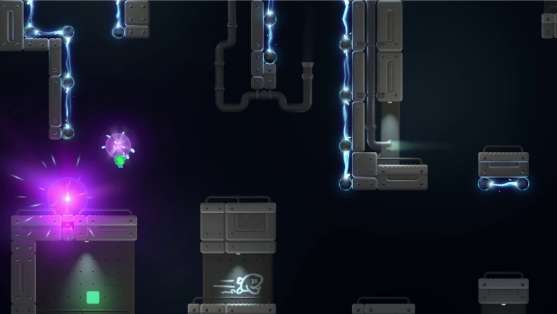
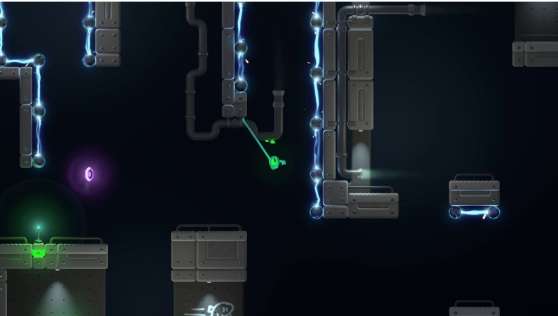
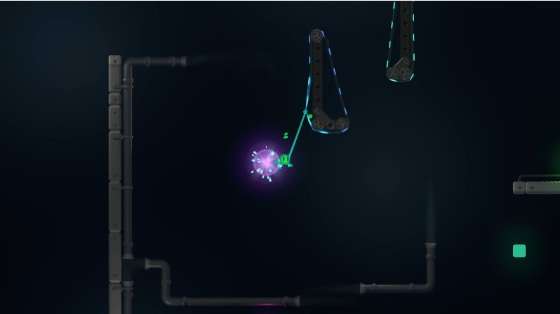
The Goopling hook is a little goo arm that Gooey can throw at walls, ceilings, and platforms to swing through space, and is the game’s major mechanic. The game’s learning curve is minimal; you’ll pretty much have mastered it within the first few levels: run, jump, launch arm. The mechanics I learned on level 1 were still holding true on level 16. There are no advanced techniques to master, no hidden mechanics to discover, no skill ceiling to push against. What you see is what you get.
In addition to Goopling, Gooey uses a few additional elements, like pipes to launch you from entrance to exit at high speed (providing the game’s only real moments of velocity). Conveyor belts add directional momentum, and electrical hazards are the only real threat (besides, you know, missing the jump and plunging into an abyss). These elements appear throughout the 50+ levels, combining to create levels focused on swinging, pipes, or conveyor belts. That’s it, that’s the toolbox, the game does not expand or seem to evolve from there.
The level design follows a consistent structure. Players navigate through the course using the gooey arm, optionally collecting the three LAB letters scattered throughout (collecting these will turn the beacon light from green to purple), avoiding electricity and falling/failing, and eventually reaching the beacon. Some levels will emphasize one element, like verticality, while others will require maintaining forward momentum in a little jump, jump, jump action.
The art is adorable, but the same color palette and visual elements remain consistent across all levels, which means the game blurs together a bit when trying to sit down and write up your thoughts about it.
The devs have explicitly marketed this as physics-based, with building up and harnessing momentum playing a large role in navigating levels. The thing is, the actual physics in the games seems to be running at .5 speed. When playing, I didn’t feel like I was ever building up the speed to really jump over a gap. And when hanging in the air, it seemed like the gravity had been turned off. This was not a true problem in the mechanics; it just wasn’t what I expected based on other platformers. I went in expecting something tighter, with more responsive controls. What I found was something a little more floaty. Less Earth’s physics, and more the Moon’s physics.
The truly funny thing to me was that I came to this realization because I was doing so well in the game! Was I flying through levels? Me? The notoriously bad at all platformers gamer? With the twitchy fingers, who once had an entire mental break from reality because of jumping on pillars in Valkyrie Profile? It is a sad day when you realize a game is not delivering on the marketing because you realize that you’re doing okay. Sigh.
The loose-goosey gravity gives extended hang time, which allows players to aim their next grapple. The floaty physics reduce the punishment for mistimed releases. The slow goo speed means you’ll never be overwhelmed with rapid-fire decisions or split-second reactions. You have time to survey upcoming obstacles, plan an approach, and execute a plan. I think this must be what Quicksilver feels.
Tangent
Now let me tell you about the moment I realized what Gooey actually is.
My four-year-old is currently obsessed with video games. Why wouldn’t he be, when he watches me play them all the time? Also, they are cool. He always begs to try my games, but inevitably, they are too advanced for him, the reading, the gameplay, the strategy, the need for rapid-fire decisions of split-second reactions. So imagine my absolute surprise, and his glee, when he picks up my controller and starts grappling onto walls, swinging over gaps, avoiding the electric barriers. He wasn’t button-mashing as he does with Super Punch Out!! He was actually reading the environment, planning moves, and solving spatial problems. He didn’t collect all the scattered LAB letters, which require more precision, but he reached the goal beacon. Multiple times, across multiple levels.
The thing is, he plays games like Baby Shark Sing and Swim Party or educational touch screen stuff designed for toddlers. But watching me play Company Man, or Hollow Knight? That’s what he wants to do. He wants to play “real” games, the kind that look cool, the kind that older kids play. Gooey gave him that. It looks like a game a teenager would play. It feels like an adult game, but it functions at a complexity level that a preschooler can actually handle.
Watching him play and succeed is when I understood what Turbo Pixel had actually created.
There is a massive gaming gap that the market has not filled, and maybe has not realized exists. On one side of it are “baby games” like Baby Shark, or educational alphabet games that mostly play themselves, and on the other side of it are family-friendly platformers like Super Mario World and Minecraft that require motor skills and processing speeds that most kids under seven don’t have yet. The entire 4-7 demographic is stuck playing stuff that feels young even to them, when what they want is to feel like a real gamer.
Gooey sits perfectly in that gap, and I think it is because the devs did such a great job of recreating the retro feel of the 80s arcade game. We were all able to pick up and play Pac-Man and Galaga for the first time we ever tried them. And that brief taste of success, the knowledge that we could play a real arcade game, kept us begging quarters from our parents.
I really believe that the aspects of Gooey that would frustrate and annoy experienced platformers are what make it absolutely perfect for a younger demographic. And excuse me while I put my nerd hat on over my other nerd hat, but have you ever heard of Vygotsky’s “Zone of Proximal Development”? This is a very fancy way of saying the sweet spot where a task is juuuuuusssst beyond a person’s current ability, but achievable with a little support. My kiddo couldn’t jump a Gooey gap at first, but after practicing pushing the joystick and pressing B at the same time, he was able to launch his new green buddy into the unknown.
Hold on, hold on, hold on, am I advocating for young developing minds to get more screen time? Yes and no. The benefits are real. Gamefied learning keeps people of all ages coming back, and with another person guiding and building on it, games can help kids develop hand-eye coordination, spatial reasoning, cause-and-effect, and frustration tolerance. Gooey’s slowed down physics check every box for being an actual teaching aid. Moderate gaming time (30ish minutes) with age-appropriate content and parent/teacher co-play can support these developments.
Even the collectible L.A.B. letters are a perfect addition to the gameplay when thinking about it through a young gamer’s lens. The letters are optional, but something to work up to, so a 6-7-year-old will be able to see their own growth, just as a 4-5-year-old (lol, 6-7).
The level editor is potentially brilliant, and I might recommend that TurboPixel approach a couple of science teachers with the game for this reason. The toolbox for level building is very limited, with the same platforms, electric hazards, and pipes that the player finds throughout the first five levels of the game. But for introducing kids to physics and game design concepts? Perfection. It’s not overwhelming like Super Mario Maker’s toolkit, but that limitation is actually a strength for say, an elementary school science teacher who wants to introduce physics concepts to their class.
This is a long tangent, but I feel an important one. TurboPixel talks about retro platforming, physics-driven challenges, and momentum-based combos. They seem excited to see what the hardcore creation community builds. The marketing says they want to position Gooey to compete with the big kids, when they need to be screaming from the rooftop, “Want to game with your kid? Here’s a real platformer that they can handle!” This is a game that bridges little kid games and “real” games. This is training wheels that don’t look like training wheels. This is what you play with your 4-year-old in TK, so they’re ready for Minecraft in 1st grade.
In conclusion, I am absolutely fascinated by how TurboPixel has created a game about escape that has itself escaped the category it was designed for.
Overall
10/10
Gooey is even better than TurboPixel realizes.
IMO the devs leaned so far into nostalgia, they somehow looped all the way back around to childhood and created a game that can and should be played by the 4-7 crowd. The slow, floaty movement that would feel wrong to the aged +30 platformer veteran is exactly right for developing motor skills. The simple mechanics that never evolve are perfect for building confidence without overwhelming complexity. The gentle difficulty that experienced players would breeze through creates just enough challenge for young players to feel genuine accomplishment.
At $9.99, this isn’t just a good deal. Turbo Pixel created something more valuable than they intended, and it wasn’t the next great indie platformer for Steam enthusiasts. It is a solution to a problem the industry hasn’t bothered solving. There’s a whole generation of kids who want to feel like real gamers but can’t access the games that would make them feel that way. Gooey gives them access and could develop skills along the way while creating opportunities for genuine family bonding.
For more information, visit Steam.
Related: Reviews by Lord Tevildo

Equal-opportunity gamer goblin.
Completionist role-player, lore-lover, stealth archer for life.
I review games by intent, audience, and design, not marketing or hype. I forgive ambition and value games that trust the player to think.
Big nerd. No apologies.




More Stories
MARVEL MaXimum Collection Review for PlayStation 5
GDC 2026: Tides of Annihilation Impressions
Space Warlord Baby Trading Simulator Review for Xbox Series S/X