
“Legacy of Kain: Defiance Remastered” Review by Nick Navarro
Few game series carry the same kind of dark, brooding legacy as “Legacy of Kain.” The franchise has always been remembered as much for its intricate storytelling and gothic atmosphere as for its gameplay, and revisiting it decades later is a strange mixture of admiration and curiosity. When “Legacy of Kain: Soul Reaver 1&2 Remastered” arrived in late 2024 (you can check out my review of that HERE), it felt like the door had finally reopened for this long-dormant universe. Now with “Legacy of Kain: Defiance Remastered,” the final chronological chapter of the saga returns with a modern, higher-resolution coat of paint, giving players another opportunity to step back into the haunting world of Nosgoth.
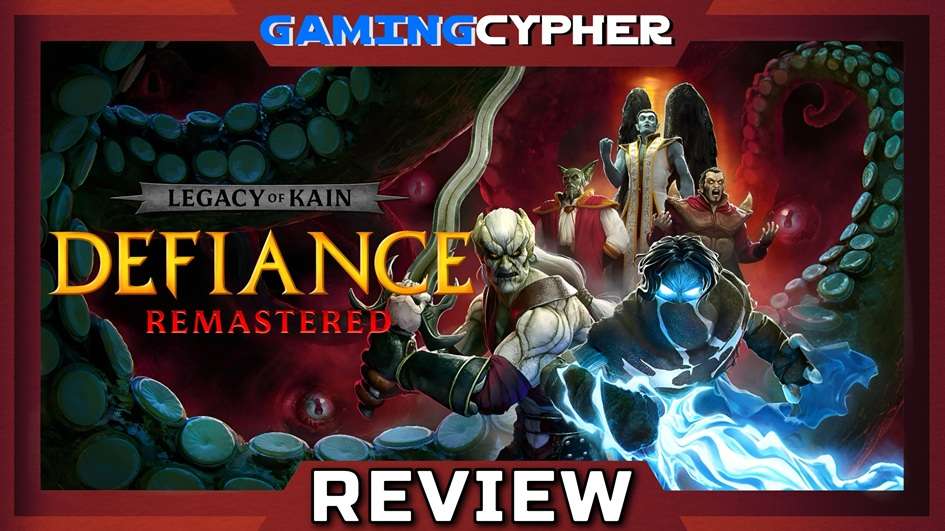
Originally released in 2003 and developed by Crystal Dynamics, “Legacy of Kain: Defiance” served as the fifth entry in the series and the point where many of the narrative threads surrounding Kain and Raziel began to converge. The remastered version doesn’t reinvent the game, but it does attempt to make this final chapter more accessible to modern audiences. Updated HD visuals, refined controls, and a modernized camera all aim to smooth out some of the rougher edges of the original release while preserving the experience that longtime fans remember. One of the most notable aspects of “Defiance” is that it allows you to control both Kain and Raziel throughout the story. Earlier games in the series typically focused on one character or the other, with the “Blood Omen” titles centered around Kain while the “Soul Reaver” games followed Raziel. Here, however, their destinies become intertwined as the narrative alternates between the two perspectives. The story picks up where “Soul Reaver 2” left off, with Kain saving Raziel from becoming permanently bound within the Soul Reaver blade, creating a time paradox that further destabilizes the history of Nosgoth.
Gameplay revolves around combat, exploration, and puzzle-solving within large gothic environments filled with enemies and secrets. Both Kain and Raziel wield the legendary Soul Reaver, though each version of the weapon exists in different forms. Kain carries the physical blade while Raziel commands its spectral counterpart along with several elemental variations. This distinction helps give each character their own combat identity, even though the overall structure of the gameplay remains similar between the two. Kain’s abilities revolve around enhancing the Soul Reaver through various emblems such as balance, conflict, dimension, energy, and time. These upgrades expand the weapon’s functionality while also granting powers like pyrokinesis that can interact with the environment. Raziel, on the other hand, retains many of the abilities he possessed in earlier games, including access to elemental reavers that grant unique powers. One example is the Dark Reaver, which allows Raziel to become invisible and slip past certain enemies and obstacles without being detected.
While these systems still function well enough, it’s also clear that the core gameplay design reflects its early-2000s origins. Combat can become repetitive during longer stretches, and some sequences feel less refined compared to modern action-adventure standards. Even with the improvements introduced in the remaster, moments of clunky controls and occasionally stubborn camera angles can still remind players that this is very much a product of its time. Where the remaster truly succeeds is in the effort to modernize the presentation without stripping away the identity of the original game. The HD visual upgrade gives environments and character models a noticeable improvement while still maintaining the dark, gothic style that defines the series. Being able to toggle between the modernized visuals and the original presentation at any time is also a welcome feature, especially for players who want to see how the game has evolved visually.
Additional extras help flesh out the package as well. A photo mode allows you to capture moments throughout Nosgoth’s bleak landscapes, while alternate character skins inspired by the wider Legacy of Kain canon provide some cosmetic variety. The inclusion of a lore reader is particularly fitting for a series known for its dense storytelling, and the addition of unreleased content and “lost levels” from the original game offers an intriguing look at material that didn’t make the final cut back in 2003. Despite those improvements, the remaster doesn’t completely solve some of the original game’s shortcomings. Certain gameplay systems still feel dated, and the balance between combat and puzzle-solving can sometimes lean toward repetition. Even so, the effort to preserve and present the game in a modern format is clearly evident, and the result is far more convenient than digging out old hardware just to revisit this chapter of the series.
What ultimately carries “Legacy of Kain: Defiance Remastered” is the same thing that carried the original game: its atmosphere, storytelling, and characters. The world of Nosgoth remains a fascinating setting filled with moral ambiguity and philosophical themes surrounding destiny and free will. Kain and Raziel continue to be compelling protagonists whose intertwined journeys give the series its dramatic backbone. For returning fans, this remaster easily stands as the definitive way to experience the final chapter of their story. The improvements to visuals, controls, and accessibility make it far easier to revisit than the original release, and the added content offers a few extra reasons to return to Nosgoth once more. For newcomers, that may be a tougher sell; the experience can feel like stepping into a relic from another era, particularly if they aren’t already invested in the series’ complex lore.
Even so, there’s something admirable about seeing a game like this preserved and revived for modern platforms. “Legacy Of Kain: Defiance Remastered” may not completely overcome the limitations of its original design, but it successfully brings an important chapter of gaming history back into the spotlight. Imperfect though it may be, the ride through Nosgoth remains dramatic, atmospheric, and unmistakably gothic, proof that even after all these years, this series still has a bite left in it.
7/10
For more information, visit HERE
Related: Nick Navarro Reviews

Gaming since I was given an original Nintendo as a kid. I love great storytelling and unique ingenuity. When both collide in a single game, I'm a happy gamer. Twitter/IG @NickNavarro87



More Stories
MARVEL MaXimum Collection Review for PlayStation 5
GDC 2026: Tides of Annihilation Impressions
Space Warlord Baby Trading Simulator Review for Xbox Series S/X