
“Sleep Awake” Review by Nick Navarro
My first minutes with “Sleep Awake” felt like drifting through a lucid dream that kept mutating faster than I could process it. Eyes Out’s first-person psychedelic horror narrative creates an uncanny world where sleep is no longer a source of rest but a looming threat, and that premise alone had me hooked before I even took control of Katja. Blumhouse Games, best known for its horror film pedigree, has only recently stepped into the gaming space, yet the studio’s influence is immediately felt in the game’s atmosphere, presentation, and relentless sense of dread that seeps into every environment.
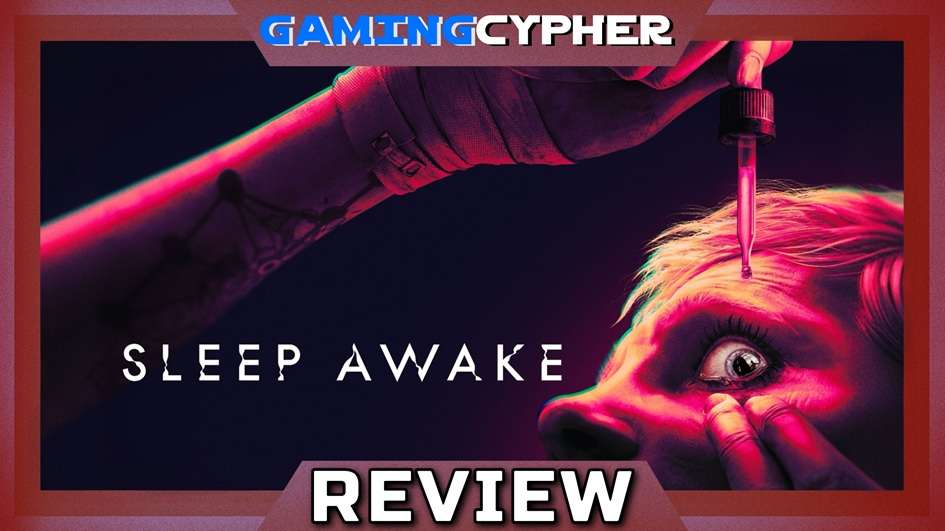
What struck me first was how thoroughly “Sleep Awake” commits to its setting. The last known city on Earth is crumbling under the weight of a phenomenon known as “The Hush,” an inexplicable force that causes anyone who falls asleep to simply vanish. The people who remain are driven to extremes, turning to hazardous experiments, desperate rituals, and fractured philosophies in a frantic bid to avoid extinction. Moving through this eroding world as Katja, surrounded by factions convinced they’ve nailed down the “right” method of staying awake, constantly reminded me how fragile humanity becomes when survival and obsession intertwine. The narrative leans heavily into the ideas of blurred perception and mental decay, and it delivers these themes in ways that feel uniquely disorienting. Reality distorts, colors swell around you, and environments twist into surreal manifestations of fear and memory. The hand-crafted environments, the bold use of color, and the unpredictable FMV injections all work together to create a visual identity that’s equal parts beautiful and unsettling. It often feels like walking through an art installation built from the nightmares of a sleep-deprived mind, and the game revels in that sensation every chance it gets.
Katja’s journey forces you to navigate the chaos left behind by humanity’s final survivors, many of whom have fallen into death cults or fringe groups convinced they’ve found purpose in the collapse. These unsettling adversaries are far more frightening for their conviction than their appearance, and slipping past them relies mostly on stealth and awareness. The stealth-based gameplay isn’t particularly innovative, and it rarely pushes beyond familiar patterns, but it gets the job done. I never found it frustrating, and it didn’t overstay its welcome, though I can’t say these sections were the main reasons I was invested. Instead, it was the story, environment, and atmosphere that kept pulling me deeper. One thoughtful design choice I appreciated is that puzzles and chase segments stay separate. The game never forces you to solve something complicated while being hunted, which preserved the pacing and made exploration feel more deliberate. Puzzles themselves range from straightforward to slightly opaque, and while one or two did leave me scratching my head longer than expected, I never felt stuck for unreasonable stretches. When I did fail a stealth or chase sequence, the game’s checkpoint system ensured I got back on track quickly. The respawn mechanic, dropping you into an endless void that reshapes around you as you walk toward a door, was a fascinating touch that reinforced the blurred boundaries between consciousness and whatever lies beyond it.
While the gameplay isn’t the star, the audio design absolutely is. Robin Finck’s (of Nine Inch Nails fame) involvement is felt in every droning buildup, every shrill sting of tension, and every hypnotic, dreamlike sequence. The soundtrack and audio cues ground the psychedelic visuals with a sense of unease that grows thicker as the story progresses. Even outside of music, the overall soundscape, voices, ambient distortions, and environmental feedback played a major role in how deeply I connected with the world. The voice acting, especially from Katja, is consistently strong and does a lot of heavy lifting in pulling emotional weight into scenes that already feel fragile and uncanny. By the time I reached the later chapters, I realized how strongly the world-building had taken hold of me. The themes of exhaustion, identity, and the fear of being consumed by sleep aren’t just narrative dressing; they’re woven directly into how you experience the environment itself. The visuals and sound work in tandem to constantly challenge your perception, creating moments where I genuinely questioned what was real within the game’s logic and what was a hallucination born from Katja’s desperation.
There are blemishes, an uninspired stealth sequence here, and a puzzle that feels a bit obtuse there, but none of these issues managed to overshadow the experience as a whole. The journey is compact, only taking up a handful of hours of your time, but it’s dense with style, ideas, and unforgettable imagery. And while the gameplay may not break new ground for the genre, the atmosphere is so meticulously crafted that it almost doesn’t matter. “Sleep Awake” thrives on its ability to immerse you in a collapsing reality where your senses can’t be trusted, and it executes that vision with confidence. When the credits rolled, I found myself still thinking about the world, the characters, and the ideas it wrestled with. It’s a game that lingers, not because it terrified me, but because it made me feel like I’d walked through a living hallucination that refused to fade after I stepped away. For a narrative-driven horror experience, that impact is exactly what I’m looking for.
8.5/10
For more information, visit HERE
Related: Nick Navarro Reviews

Gaming since I was given an original Nintendo as a kid. I love great storytelling and unique ingenuity. When both collide in a single game, I'm a happy gamer. Twitter/IG @NickNavarro87




More Stories
GDC 2026: Ballgame Impressions for Steam
GTA Online’s Neighborhood Watch Event is Back Plus New Law Enforcement Vehicles, Time-Limited Outfits, and Much More
Rock It Games Launches Bases Loaded II: Second Season and Goal! Two for Nintendo Switch and PlayStation 5