
“Kirby Air Riders” Review by Nick Navarro
Nintendo has released plenty of great multiplayer games over the years, but “Kirby Air Riders” might be one of the weirdest and most enjoyable surprises the company has delivered in a long time. The sort of experience that feels instantly approachable the moment you pick up the controller, but slowly reveals layers of depth the more time you invest into it. This Kirby game nails that balance beautifully. Even as someone who never played the original “Kirby Air Ride” on the GameCube, I found myself completely hooked by its strange blend of arcade racing, aerial combat, and chaotic party-game energy. What started as a curiosity quickly became one of my favorite games on the Nintendo Switch 2.
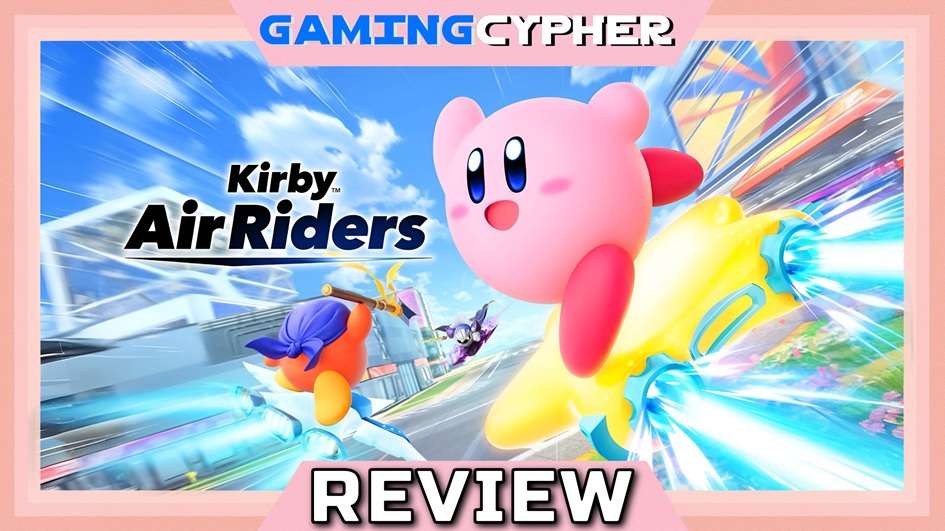
Released in November of last year (I know this is a late review, sorry) “Kirby Air Riders” feels like the kind of passion project that only someone like Masahiro Sakurai could deliver. The game carries his fingerprints all over it, from its unconventional mechanics to its obsession with replayability and meaningful progression systems. While mascot racers are hardly rare these days, “Kirby Air Riders” manages to carve out its own identity almost immediately. At first glance, the controls seem deceptively simple. I’ve been told it’s similar to the first one, movement is largely automatic, with players relying heavily on a single Boost Charge button to handle braking, drifting, and accelerating. Initially, I assumed this streamlined approach might make the gameplay feel shallow. Instead, it becomes the foundation for something remarkably nuanced. Timing your drifts properly, managing your boost gauge, weaving around attacks, and knowing when to unleash specials creates a rhythm that feels unlike any other racing game on the market.
The beauty of “Kirby Air Riders” is how naturally it scales with player skill. Beginners can jump in and have fun within minutes, while more experienced players can spend hours mastering vehicle handling, boost optimization, and character-specific strategies. The simplicity never comes at the expense of depth. If anything, the stripped-back controls allow the game’s
mechanics to shine even brighter. Combat also plays a major role in races and arena battles, adding an extra layer of unpredictability to every match. Spin attacks can send rivals flying across the track, while Copy Abilities dramatically shift the pace of competition. Some abilities provide offensive advantages, while others focus more on mobility or defense. The constant swapping between racing and combat creates wonderfully chaotic moments that feel perfectly suited to Kirby’s bizarre universe.
The starter roster immediately gives players a nice variety of playstyles to experiment with. Kirby remains the versatile all-rounder, while King Dedede feels heavier and more aggressive thanks to his explosive Jet Hammer ability. Meta Knight’s speed-focused Night Wing special quickly became one of my personal favorites, especially during aerial sections that demand quick reactions. Even Waddle Dee manages to stand out thanks to his surprisingly useful Spear Cyclone move. Each rider feels distinct without becoming overwhelming, which once again speaks to how well balanced the game’s design philosophy is. What surprised me most, though, was just how much content is packed into this package. “Kirby Air Riders” doesn’t feel like a lightweight multiplayer distraction. It feels enormous. The return of City Trial alone could have carried the experience, and it’s every bit as addictive as longtime fans claimed it would be. Running around sprawling maps collecting upgrades before a final randomized event creates an incredible gameplay loop that constantly encourages “just one more match.” Every round tells its own story, whether you spend the session hunting for stat boosts, sabotaging opponents, or desperately trying to survive the chaos unfolding around you.
Beyond City Trial, the game offers traditional races, combat-focused arenas, online multiplayer, unlockable riders, customizable machines, and even a surprisingly engaging single-player story mode centered around Zorah and the mysterious Galactic Nova. The narrative itself is strange in that wonderfully earnest Kirby way, blending cosmic sci-fi concepts with whimsical charm. While I wouldn’t necessarily call the story groundbreaking, it does give the game a stronger sense of purpose and progression than I expected going in. Visually, “Kirby Air Riders” is fantastic on the Nintendo Switch 2. The colorful environments pop with personality, the
animations are incredibly fluid, and the sheer speed of some races can be genuinely exhilarating. There’s a wonderful sense of motion throughout the game, especially during high-speed boost sections where entire tracks blur past in a rush of color and particle effects. Even when the screen becomes chaotic with attacks, explosions, and airborne collisions, the action remains readable and responsive.
I always love to give soundtracks a shout out when they impress me and this one deserves special recognition as well. Composers Shogo Sakai and Noriyuki Iwadare deliver an energetic and memorable score that perfectly complements the game’s frantic pacing. Several tracks immediately lodged themselves into my brain after only a few matches. The music constantly reinforces the sense of momentum and excitement, whether you’re soaring through futuristic skies or battling rivals in cramped arenas. If there’s one area where “Kirby Air Riders” occasionally stumbles, it’s track variety. While the courses themselves are creatively designed, I did find myself wishing there were simply more of them. A few additional environments could have helped reduce repetition during longer play sessions. That said, the strength of the core gameplay loop largely compensates for this issue, especially once online multiplayer enters the equation.
Speaking of online play, I was genuinely impressed by how smooth the experience felt overall. I suppose I still haven’t dabbled with online gaming much with my Switch 2, but matches loaded quickly, races remained stable, and the game does an excellent job encouraging repeat play through unlockables and progression systems. It quickly became one of those games I kept returning to nightly for a few quick matches that somehow turned into hours. What makes “Kirby Air Riders” special is its willingness to embrace weirdness. So many modern racing games chase realism, oversized rosters, or endless live-service gimmicks. This game feels refreshingly focused on pure fun. It understands exactly what it wants to be and commits to that vision wholeheartedly. Beneath its adorable presentation lies a deeply rewarding arcade racer packed with creativity, personality, and mechanical depth.
Even coming into this as a newcomer with no nostalgia for the original, I completely understand why fans had been waiting so long for a follow-up. “Kirby Air Riders” doesn’t merely revive an old cult classic. It elevates the concept into something that feels fresh, modern, and surprisingly ambitious. Between its inventive gameplay systems, excellent multiplayer, rewarding progression, and endlessly charming presentation, it stands as one of the strongest Nintendo Switch 2 exclusives so far and one of the most unique racing games I’ve played in a while.
9/10
For more information, visit HERE
Related: Nick Navarro Reviews

Gaming since I was given an original Nintendo as a kid. I love great storytelling and unique ingenuity. When both collide in a single game, I'm a happy gamer. Twitter/IG @NickNavarro87



More Stories
Nintendo Download Update (July 2, 2026)
Corsair Cove Preview for Steam
SAND: Raiders of Sophie Review for Steam Early Access